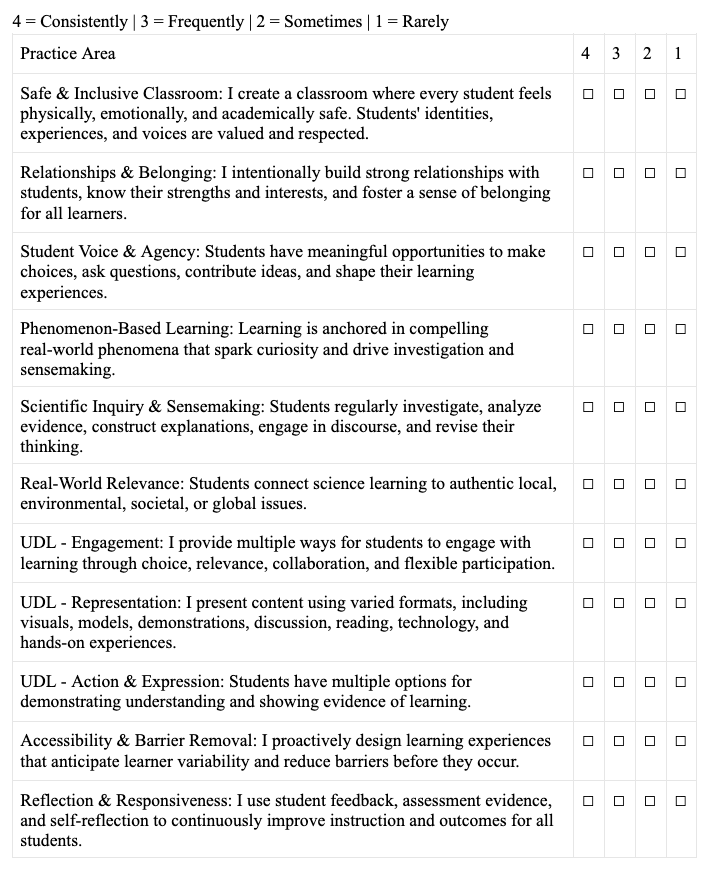
My Self Assessment:
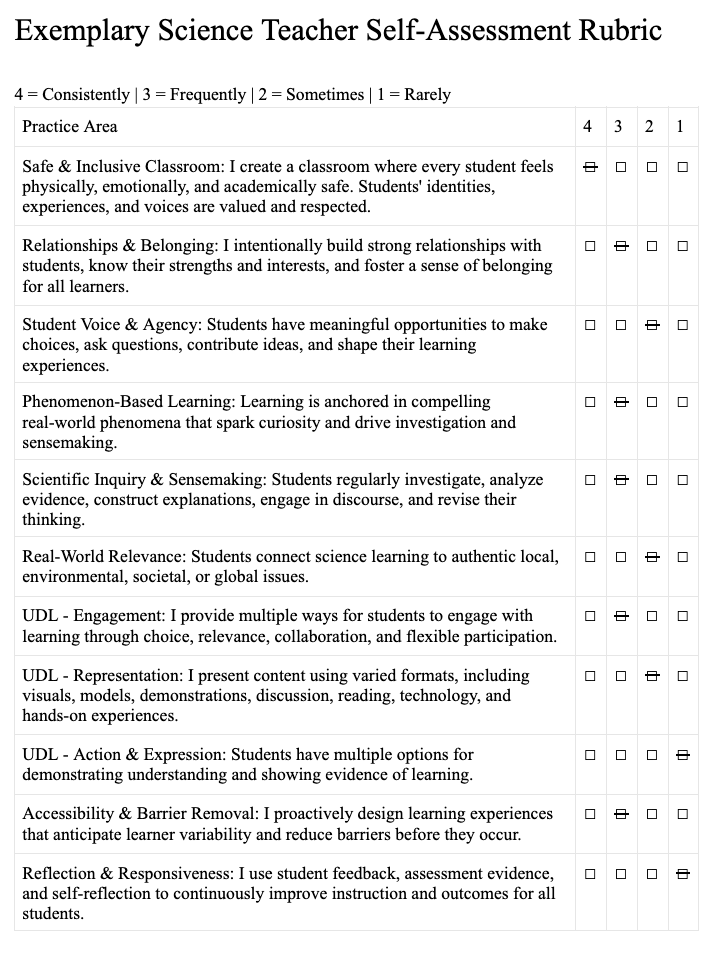
Self Assessment Reflection
Areas for growth:
Moving forward, I will provide more learning opportunities, not just what I believe is convenient for me. Giving students the option to work digitally or on paper will be my first choice. I also want to give students the flexibility to learn at their own pace and share their ideas with their peers. I also want to use more data-driven feedback, such as tests and student feedback, to make me a better teacher. Once I know what my students need, I will become a better educator by working with them.
One action I will take to improve my practice:
Moving forward, I am going to provide several means of engagement while also incorporating more structured student feedback and exam scores. In the future, I also want to connect their learning with future learning and new ideas. At the end of each Unit, I will provide students with an online survey. I will give them time in class to complete it, and they will be able to tell me what worked, what did not work, and areas they can improve, as well as areas I can improve. This working relationship will greatly benefit students and provide them with all the means they need to succeed.
Artifacts
Artifact 1 – Observation Comments from Supervised Teaching Regarding Preparation (InTASC Standard 7)
(well organized, detailed lesson plan, demonstrates understanding of the components, builds on students’ prior knowledge and ensures all materials are available.)
Ms. Wilson’s lesson plan and her rationale for designing the observed lesson was completely aligned with best practices associated with Three-Dimensional teaching and learning, including the mindset for innovative science teaching. Her plan demonstrated that she is well-versed in the component of 3D teaching that she is well-versed in the components of 3D teaching. On the board, she displayed a reminder to collect cell phones and find assigned seats. Throughout the lesson, she referred to prior knowledge to help students connect prior knowledge with new knowledge (she referred to vocabulary and organelles, for example). “Do we remember which organelles cellular respiration starts with?” At the start of the lesson, she introduced the learning objective and quickly reviewed associated vocabulary. Students were equipped with all the materials they needed for the lesson, and materials were easily accessible. Routines were well-established, and the reminders that Ms. Wilson gave them were quite helpful.
Artifact 2 – Observation Comments from Supervised Teaching Regarding Classroom Management (InTASC Standard 3)
(Maintains student engagement and ensures active participation. Routines are responsive to student needs, disruptions are managed respectfully, and positive reinforcement is consistently applied.)
Ms. Wilson has clearly established positive working relationships with her students. It is evident in all her interactions that she truly cares about their learning, engagement, and well-being. As a result, her classroom management was impressive. When students feel safe and cared for, they cooperate and make the most out of their learning experiences. She drew one of the students’ diagrams on the board, fostering relationships, and boosting self-esteem. At one point, Ms. Wilson was unsure about the way she translated a sentence. She turned to her student and asked “Can you check my translation,” which was evidence to support the comfortable and safe relationships she’s established in this short period of time whilst also demonstrating how much she values student input.